
How the Allen Parish Court Calendar Works
Two divisions make up the 33rd Judicial District Court. Each posts its own static public calendar page, Docket A and Docket B. These are Allen Parish court schedule sources only. They are not a statewide calendar. Rows are grouped by date. Many show the time, courtroom, a hearing or docket label, a case number, and a case style. Civil, criminal, traffic, juvenile, and hearing entries all appear in the visible examples. Still, no row lists every filed event in a case.
The second channel is the vendor-hosted ClerkConnect Court Events inquiry. A last name is required to search it. First name and date of birth are optional. The results come back in a structured format. Neither channel proves a case was heard, decided, dismissed, or completed. Treat both as scheduling views.
The Allen Parish Docket A page, the Allen Parish Docket B page, the Allen Parish Court Events inquiry, the Allen Parish calendar row, and the Allen Parish Clerk record each cover a different slice of scheduling access. Before trusting a date, an Allen Parish calendar query should agree with the Allen Parish division record. It should also match any Allen Parish minute or order, and the Allen Parish Clerk confirmation.
Allen Parish Docket A and Docket B
Both Docket A and Docket B are free public HTML schedules. No registration is needed. When you know a date, label, or case number, browser find works well. It searches the static page fast. The two pages exist because the 33rd JDC runs two divisions. For a current minute or document, though, the Clerk's official record is the stronger source. The Docket B page itself displays the official calendar.
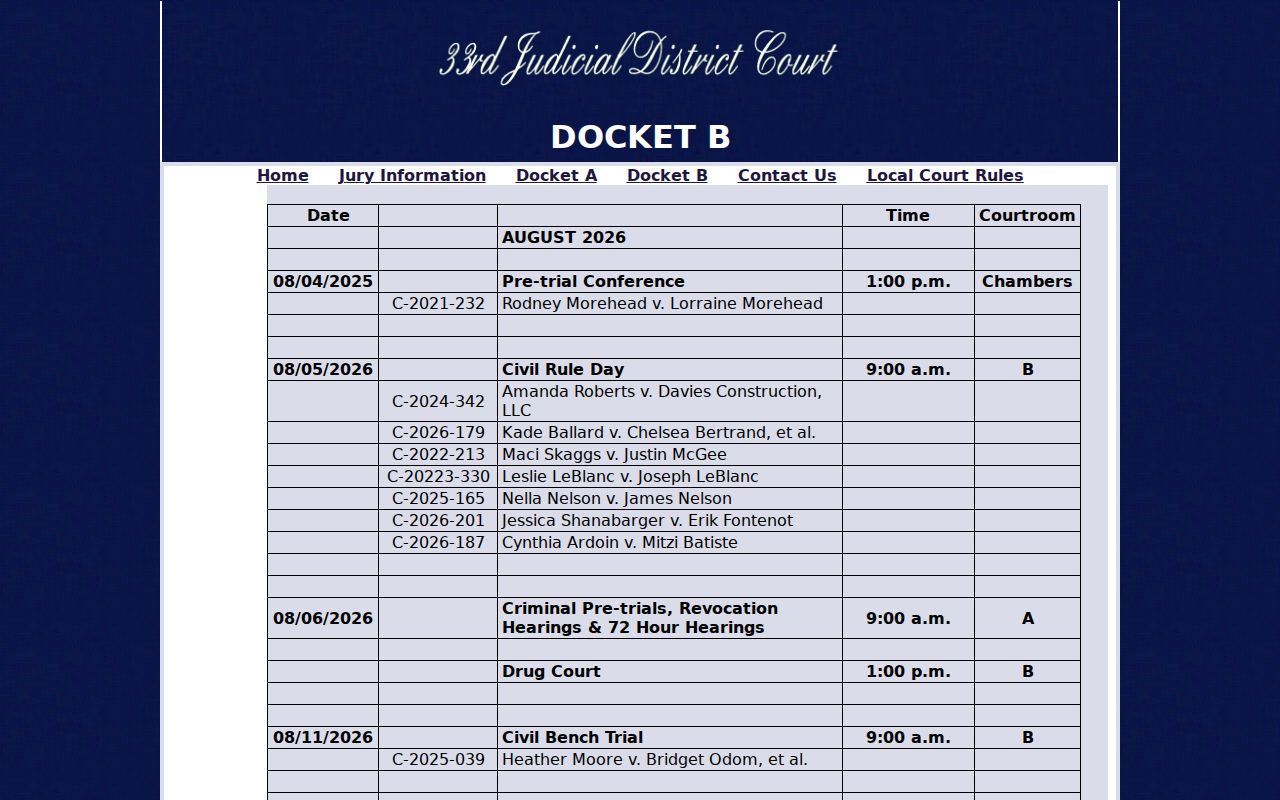
Write down what the page shows. Record the date, time, courtroom, setting label, and case number exactly as displayed. One caution: the Docket A page carries a document title that does not match its visible heading. So trust the URL and the visible page, and confirm the division if that distinction matters for your next step. The Allen Parish date field, courtroom field, setting label, and case number are all calendar-specific facts. Each is worth saving from the Docket pages.
Allen Parish Court Date Lookups
Before any Allen Parish court schedule search, check the notice, citation, petition, or prior minute. That tells you which court you are dealing with. District-court matters are worth checking in both Docket A and Docket B. Local rules rotate civil and criminal months. Neither division holds exclusive subject-matter jurisdiction. A traffic citation may belong instead to Oakdale City Court or a mayor's court. In that case, call the local court first.
- Read the issuing court, case or ticket number, and appearance information on the document in hand.
- For a 33rd JDC matter, check Docket A and Docket B by date and setting label.
- Search ClerkConnect Court Events by last name, then add first name or date of birth when needed.
- Use the returned case or suit number to check the relevant civil or criminal inquiry, subject to its access conditions.
- Compare the online date, courtroom, judge, and hearing type with the latest notice or minute.
- For a changed, sealed, non-posted, or unclear setting, contact the Allen Clerk or assigned division before appearing.
Phone numbers are the fastest check. The Allen Clerk's main line is (337) 639-4351; Division A is (337) 639-2266, and Division B is (337) 639-2256. The 33rd JDC contact page lists the division contacts. Mail, email, and the clerk counter also work as record-access channels, though the clerk offers no separate online appointment or calendar-request form. The strongest sequence pairs an Allen Parish notice or citation and case number with the Allen Parish Court Events query, a division call, and final Allen Parish Clerk confirmation.
Allen Parish Court Events Fields
The ClerkConnect event form asks for a last name. Both the first name and the date of birth are optional. Result fields include date and time, case or suit number, type, name, date of birth, civil caption, courtroom, judge, and hearing type. A broad search triggers a warning. Only 100 events display. Keep in mind this is an event search. It is not a full case register or a copy of every underlying filing. The official Court Events page presents the inquiry form itself.
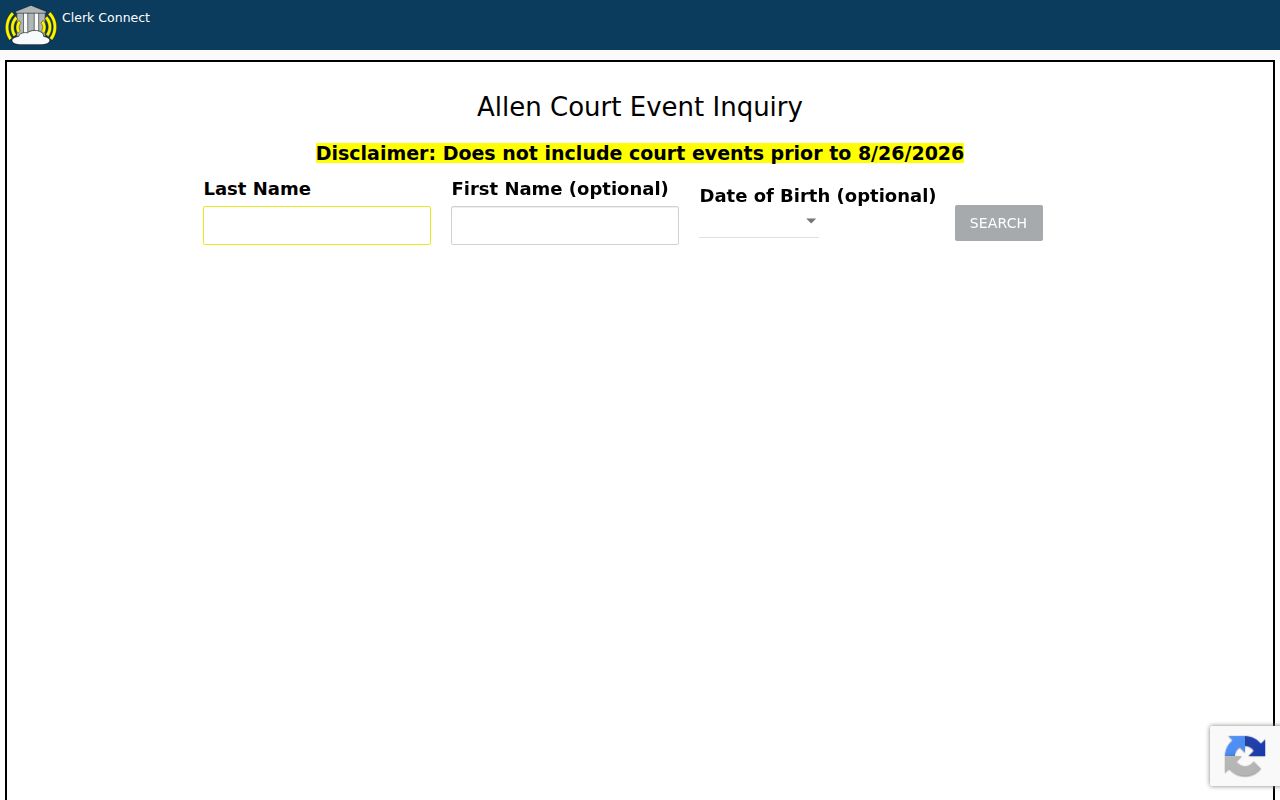
Treat any case or suit number you find there as the strongest bridge. It links straight to the matching ClerkConnect civil or criminal search. The Allen portal publishes no promise about how often event results refresh. So note the time you ran the Allen Parish last-name search. The Allen Parish optional first name, optional date of birth, event result, hearing type, and 100-result warning all shape what the Court Events channel can show. Some things it simply cannot.
Court Settings: What Each Field Means
A setting is a scheduled appearance or hearing. It is not a final outcome. Read every displayed field before drawing a conclusion from an Allen Parish calendar row. "Chambers" means the place shown is chambers, not a courtroom. The case style or caption is just a public-facing label; the case number is the more reliable identifier to carry to a clerk or portal search.
| Date | The scheduled date shown by the source, not proof that the case was called or resolved. |
|---|---|
| Time | The listed start time for the setting or docket item. |
| Courtroom | The room or chambers location displayed in the calendar result. |
| Judge | The assigned judge field when Court Events supplies one; rotations and allotment can affect expectations. |
| Setting type | A label such as arraignment, motion, rule, traffic, civil bench trial, or 72 Hour Hearing. |
Labels like "Pre-trial Conference," "Civil Bench Trial," and "Traffic" only tell you what kind of setting appears on the docket. They settle nothing. A court docket row with an Allen Parish setting date, setting time, courtroom, judge field, hearing type, and case style is schedule information. Read it that way. Without the supporting official minute or order, no legal result follows from the entry.
Allen Parish Calendar Labels
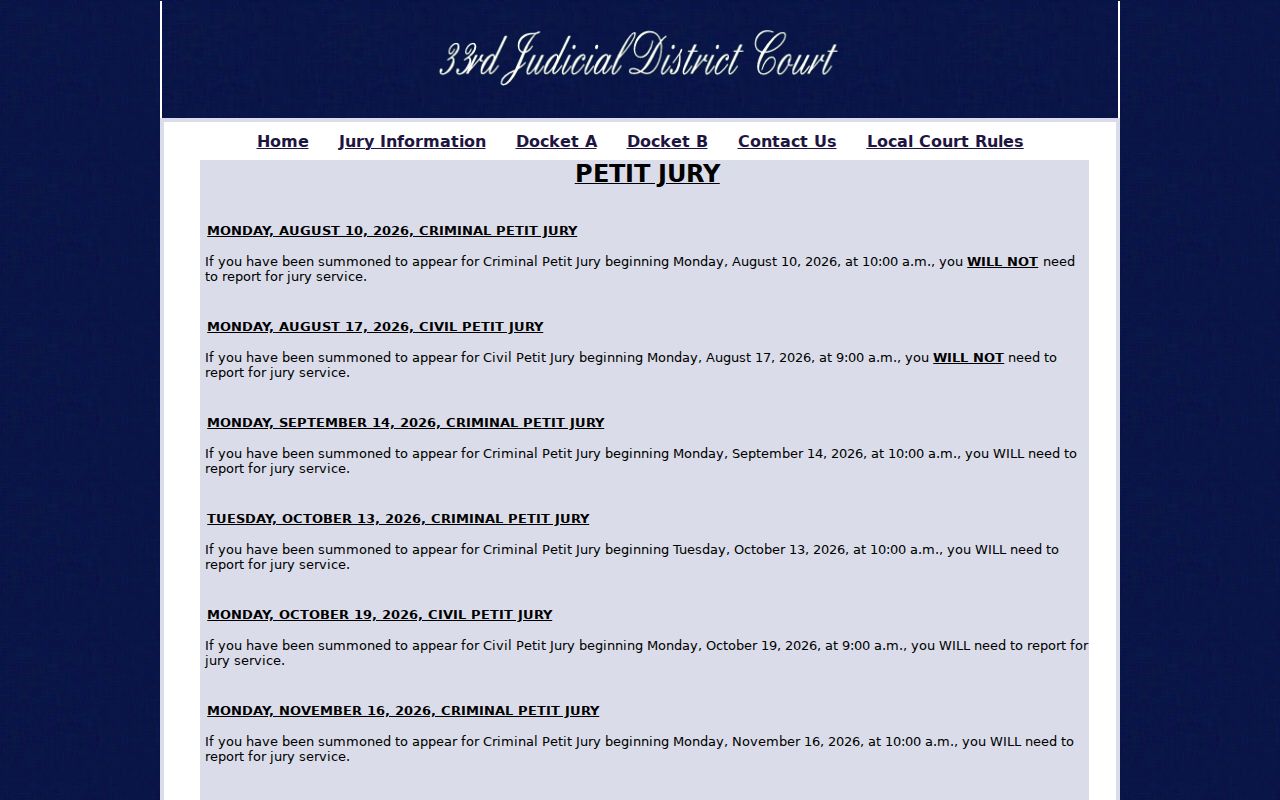
The 33rd JDC calendars speak in local vocabulary. Expect headings like Traffic and 72 Hour Hearings, Criminal Motions and 72 Hour Hearings, Civil Rule Day, Civil Hearing, Civil Bench Trial, Civil Jury Term, Criminal Jury Term, Felony Arraignments, Non Support, Probation Hearings, and Juvenile Delinquency. None of these is a disposition. A label marks a block of settings on the court calendar, nothing more. It does not prove a separately administered specialty program exists. It cannot tell you how a matter ended, either. The 33rd JDC jury information page posts official jury schedule details from the court itself.
Some juvenile entries need extra care. A heading like Juvenile CINC or a 72-hour label can show up on the calendar. Meanwhile the underlying juvenile file stays confidential. Seeing the label grants no access. The file remains restricted regardless of what the calendar displays. Allen Parish Traffic labels, 72 Hour Hearings, Civil Rule Day, bench-trial settings, jury terms, and juvenile labels are calendar vocabulary. Each has its own limits.
When a Court Date Moves
Court dates move. A continuance, reset, cancellation, or closure can shift an Allen Parish court schedule overnight. The public pages publish no universal last-updated field. Nor is there a complete change log for every setting. A reset may surface only after the clerk records the minute entry. Or it may wait until the new date goes up. So treat a web row as "scheduled for." It is never proof that a hearing happened or a disposition was entered. Rank your sources. The most recent order or minute entry comes first. Direct confirmation from the clerk or the division comes second. The current Docket A/B page or Court Events result comes third. A cached page, copied calendar, or third-party listing ranks below all of those. The 33rd JDC local rules page sets out the rotation framework behind the calendars. Closures prove the point. The Louisiana Supreme Court recorded a 33rd JDC closure during Tropical Storm Francine in September 2024. A noon closure notice followed in May 2025. Those dated notices show that weather and operational events can affect a setting. They are not standing changes to the court's schedule. When a closure seems possible, check the court's live information. Then confirm directly rather than extrapolating from an old notice. Keep a short note of the source and the time you checked. That habit separates a current official calendar from a notice, a cached copy, or a prior setting that was continued. In Allen Parish, a minute entry, court order, division confirmation, Docket A row, Court Events result, and closure notice each carry different weight. Use that order when a date moves.
Allen Parish Division Rotation Months
The divisions split the year. Division A handles criminal matters in February, April, June, August, October, and December. Civil months are January, March, May, July, September, and November. Division B runs the opposite rotation. That pattern is why both calendars matter even when you expect a case type to sit in one division. The local rule controls allotment. The web calendar serves as the public operational display. The official local rules source publishes the rule text itself.
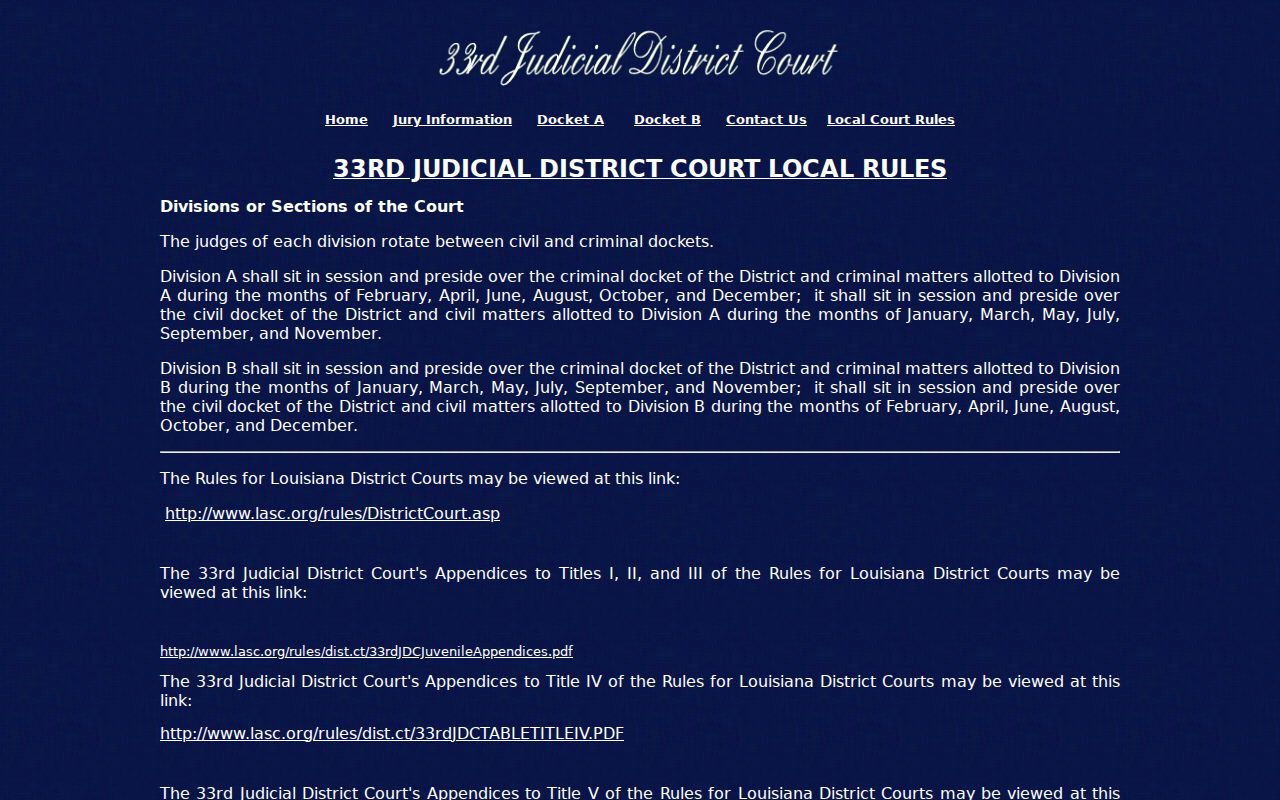
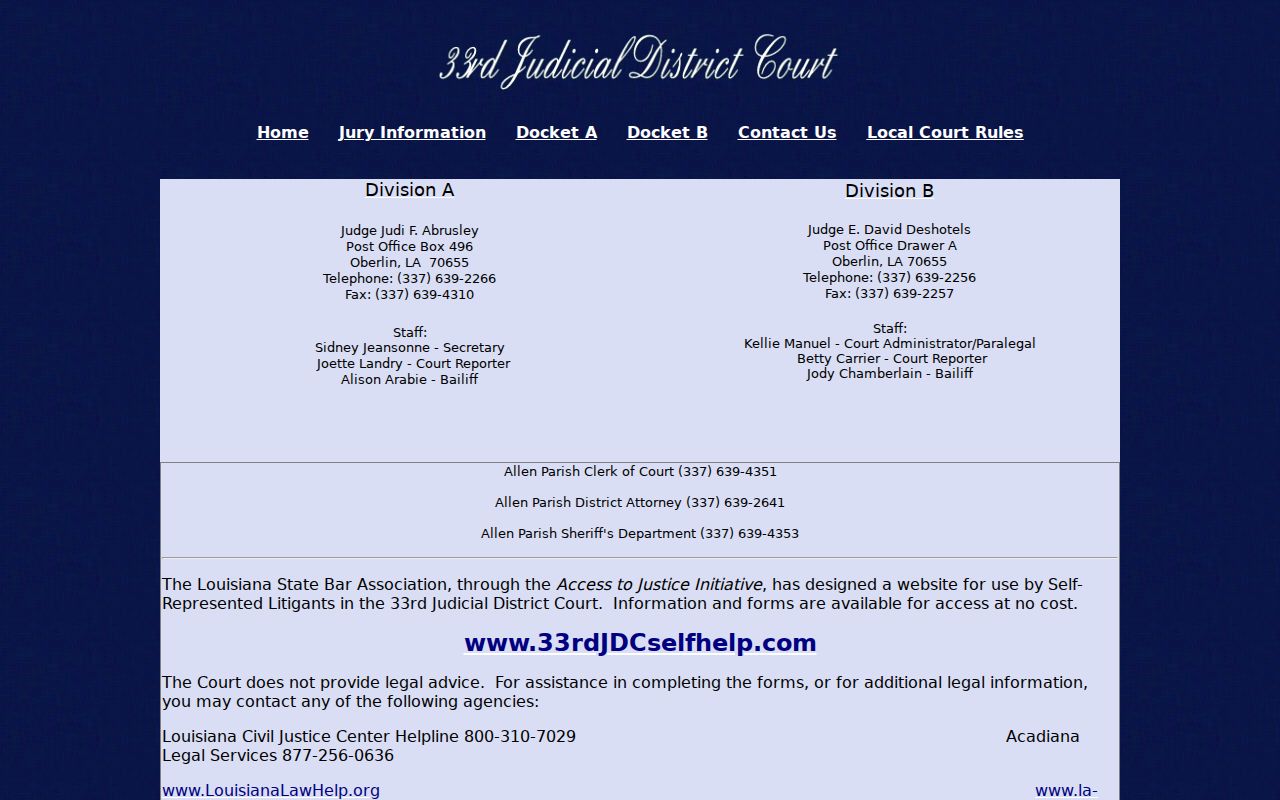
For a date you must confirm directly, the official court contact information gives the court's numbers.
Check the current calendar first. Then use the responsible division. A past entry can be history rather than the date that controls today. Allen Parish Division A criminal months, Division A civil months, Division B rotation, local rules, docket allotment, and the public calendars together explain why both schedules matter before you trust either one alone.
Missed Settings and What Comes Next
Miss a setting? Act fast. Confirm through the court or the attorney involved. No universal Allen consequence applies to every missed hearing, so promising the same order or next date for each absence would be wrong. Pull the case number and the most recent notice you have. Then contact the Allen Clerk or the assigned 33rd JDC division for the current official status and the right next step.
Confirm before appearing: A changed or missed setting can have serious case-specific consequences. Call the responsible clerk or division promptly, follow any court notice, and obtain legal advice when it is needed for the matter.
The court website asks attendees to arrive 30 to 45 minutes early. Cell phones are prohibited. Those attendance rules matter, but they do not replace confirming the current setting. Before any public calendar appearance, keep the notice and case number handy. Confirm the court and division. Allow time for the published security procedures. The schedule tells you the place and time. The current court notice stays the authoritative document to follow. When you request a current date, name the case number and the assigned venue. Add party information if you know it. That gives the Clerk or division a far better starting point than a general calendar description. Check each piece before anyone relies on an old calendar row. That means the Allen Parish missed setting, the current notice, and the case number. It also means the division contact, the security rule, and the court instruction.
Allen Parish Lower-Court Date Routes
City, mayor's, and justice-of-the-peace cases run on separate calendars in Allen Parish. Each has its own clerk. A citation naming Oakdale City Court belongs at that court, not on a 33rd JDC docket. Kinder, Oberlin, and Reeves each run a mayor's court. None of the three posts a full public docket portal. Call the municipal court to confirm a date.
Go by the court named on the document itself. Say a lower-court case turns up nowhere in Docket A, Docket B, or ClerkConnect Court Events. Those district channels are simply the wrong place. Ask the issuing court directly how it sets and reports dates.
Note: The venue answer may sit right on the citation. That can hold true even when the countywide schedule routes return no match at all.
An Allen Parish Oakdale date, a mayor's court date, a JP date, and a district-court date can each lead through a different channel. The same goes for an Allen Parish issuing citation versus a lower-court custodian. Checking the right office first saves a wasted docket search.